

BLOG
HOMOGENIZATION OR SUSPENSION? WHAT IS THE ACTUAL GOAL?

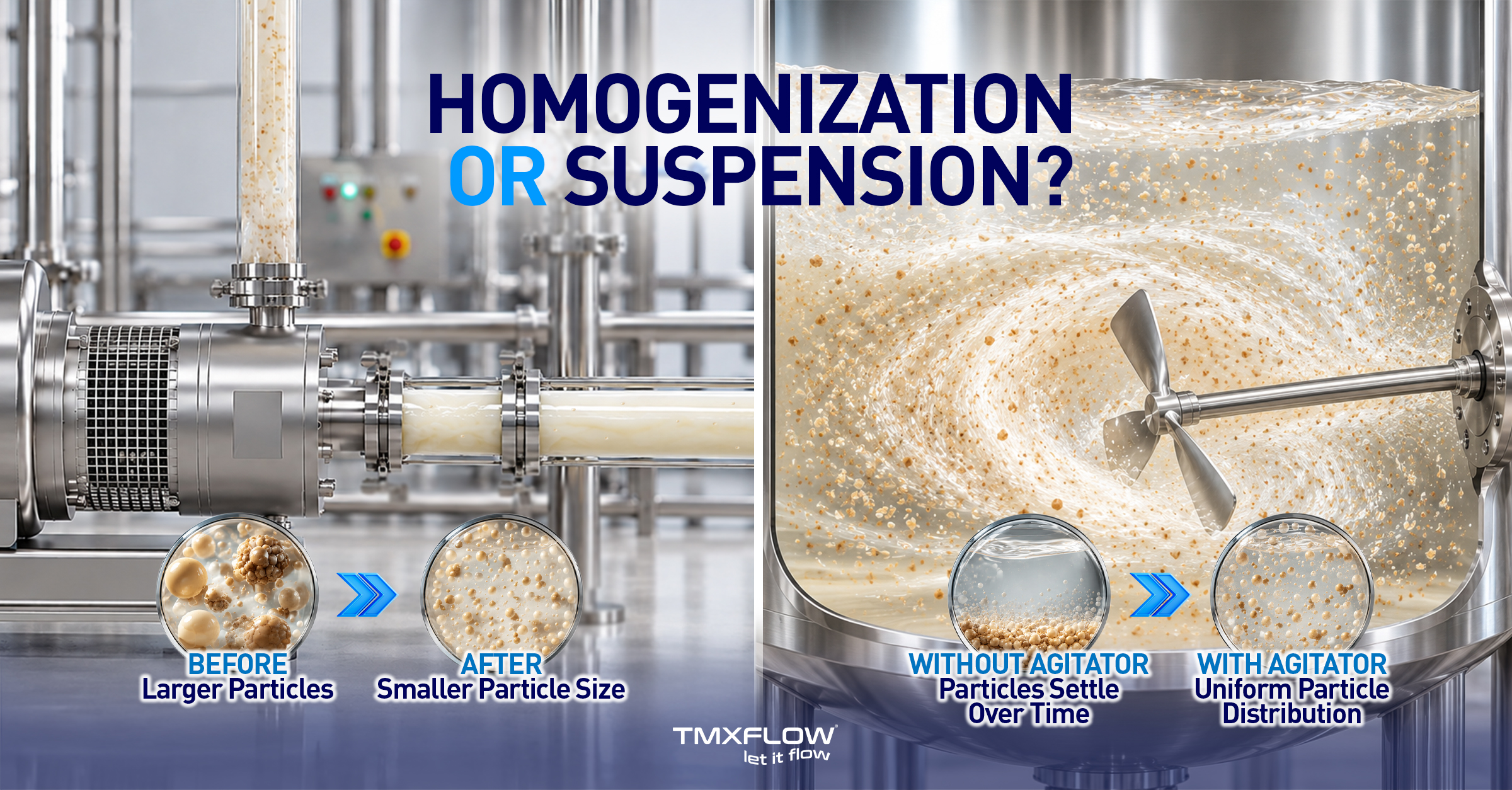
When a process involves particles, droplets, or different components that need to be distributed within a liquid, the first question is not always:
“Which pump or mixer do we need?”
It is:
“What exactly needs to happen to the product?”
Homogenization, dispersion, and suspension are often mentioned together, but they describe different processing objectives.
Homogenization generally aims to reduce particle or droplet size and achieve a more uniform distribution throughout the product. Especially in emulsions, the objective may be to break larger droplets into smaller ones and create a more stable structure.
Dispersion is the process of distributing one material throughout another phase. This may involve incorporating powders or solids into a liquid, wetting the material, and breaking down agglomerates to achieve a more homogeneous distribution. Therefore, dispersion does not simply mean “even distribution”; depending on the application, particle or agglomerate breakdown can also be an important part of the process.
Suspension, on the other hand, focuses on keeping solid particles distributed within a liquid and preventing or minimizing sedimentation. The main objective is not necessarily to reduce particle size, but to maintain the desired particle distribution during processing, transfer, or storage.
Why does this distinction matter?
Because achieving a homogeneous product is not simply a matter of increasing speed, shear, or mixing time.
In homogenization, the required energy and shear depend on the initial particle or droplet size, the desired final size, and the properties of the product.
In dispersion, the material may need to be incorporated into the liquid, properly wetted, and agglomerates may need to be broken down and distributed throughout the product. The required shear and energy therefore depend on the product properties and the desired result.
For suspension, the priority is to provide sufficient circulation and movement to prevent particles from settling. Particle size, concentration, density, and liquid viscosity are important parameters in this process.
These differences directly influence the process conditions and the equipment required.
A process designed to reduce particle or droplet size requires a different approach from one intended to maintain an existing particle distribution. Similarly, a product that remains homogeneous during mixing may behave differently once agitation stops or the product enters a transfer line.
Understanding the product alone is therefore not enough.
It is also necessary to understand the desired outcome, the product characteristics that must be preserved, and how the product will behave throughout the process.
The objective is not simply to mix or transfer the product, but to achieve the required result under the appropriate processing conditions.
The first step toward selecting the right equipment is understanding the actual purpose of the process.